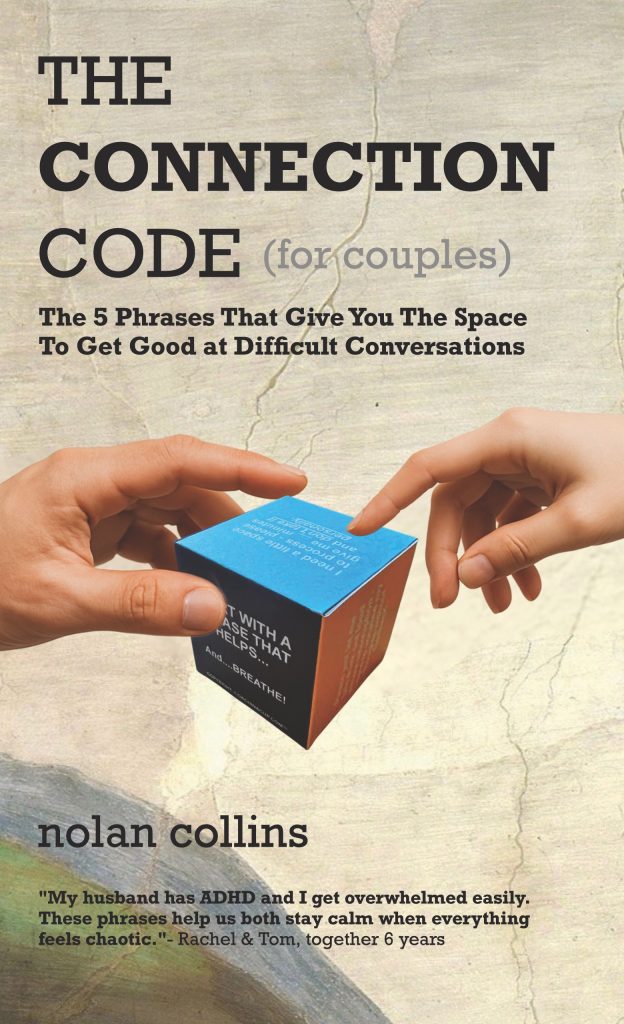
THE CONNECTION CODE
Five phrases that work even when your brain doesn’t.
Most couples know what they want to say. The problem is the moment when they can’t say it. The Connection Code gives you five specific phrases for those exact moments. Colour-coded. Practised. Ready AND at hand before the converation starts.


THE REAL PROBLEM
Haven’t you had this exact argument before?
You know the one. It starts small. A tone of voice. Something left unsaid. The dishwasher loaded differently. And within minutes you’re not talking about the dishwasher at all. You’re back in 2019, relitigating something that was never properly resolved, both of you feeling unheard and neither of you quite sure how you got here again.
It is not that you don’t care. It is not that you haven’t tried. Most couples can discuss world politics without raising their voices. They just somehow can’t discuss the sock on the floor without it turning into something bigger.
That is a communication loop. And the frustrating part is this: you can see it happening in real time, predict exactly what the other person is about to say next, and still not be able to stop it.
“Poor communication isn’t a character flaw. It’s a skills gap. And the moment you need those skills most is precisely when your brain makes them hardest to access.”
WHY WILLPOWER ISN’T ENOUGH
Most relationship problems aren’t communication problems. They’re pattern interruption problems.
In calm, you know exactly what you should say. You’ve thought it through. You’ve even rehearsed it. Then the moment arrives, the emotional charge goes up, and your brain does the opposite of what you planned. Working memory drops. Impulse control weakens. The reasonable, considered response you had ready becomes completely inaccessible, and the old script runs instead.
Knowing better doesn’t stop it. Wanting to do better doesn’t stop it. Communication loops feel permanent because they depend on both partners following the established script, and when emotions are high, that script runs automatically.
What actually breaks the loop is a specific phrase, practised until it is available under pressure, that signals something different before the pattern has a chance to take hold.
That is what these five phrases do. They are not summaries of good advice. They are the actual sentences, colour-coded to the emotional state that calls for them, and built to work in the moment when nothing else is coming out right.
WHAT THE BOOK CONTAINS
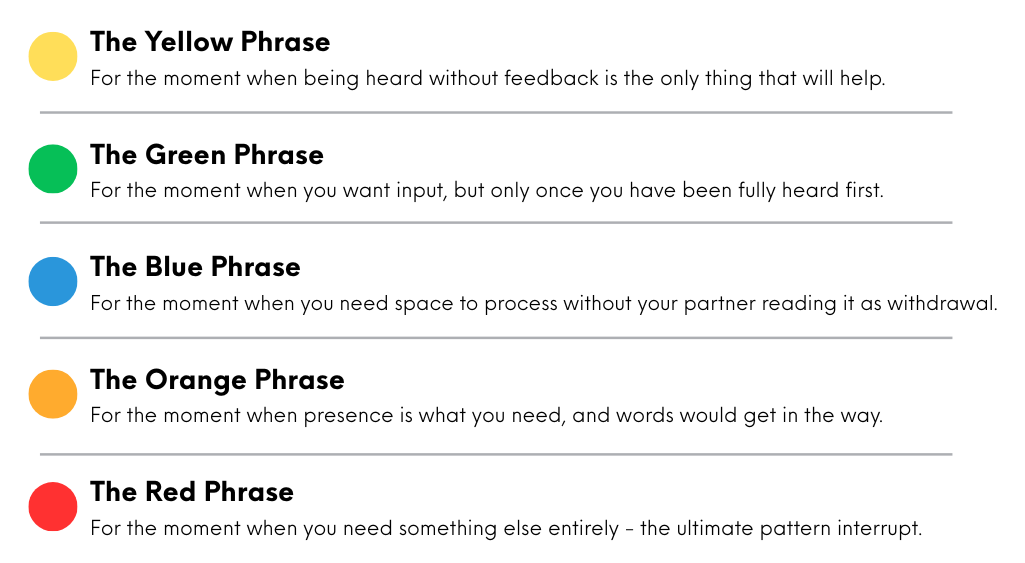
Five phrases. Each one for a different moment.Each one serving a purpose to help you connect better.
The Connection Code is built around five specific phrases, each assigned a colour that maps to a distinct emotional state. You learn to recognise the state, reach for the phrase, and interrupt the loop before it spirals. The book spends nineteen short chapters building the foundation underneath them.
What actually breaks the loop is a specific phrase, practised until it is available under pressure, that signals something different before the pattern has a chance to take hold.
ALSO IN THE BOOK
There is a physical tool in this book. You make it yourself and it goes in the room with you.
The Connection Cube is not a metaphor or an exercise. It is a tangible object with a specific function in the moment a conversation starts to go sideways. The chapter that explains it is one of the most immediately practical in the book.
It is also, consistently, the part that partners who were reluctant to engage with the book pick up first.
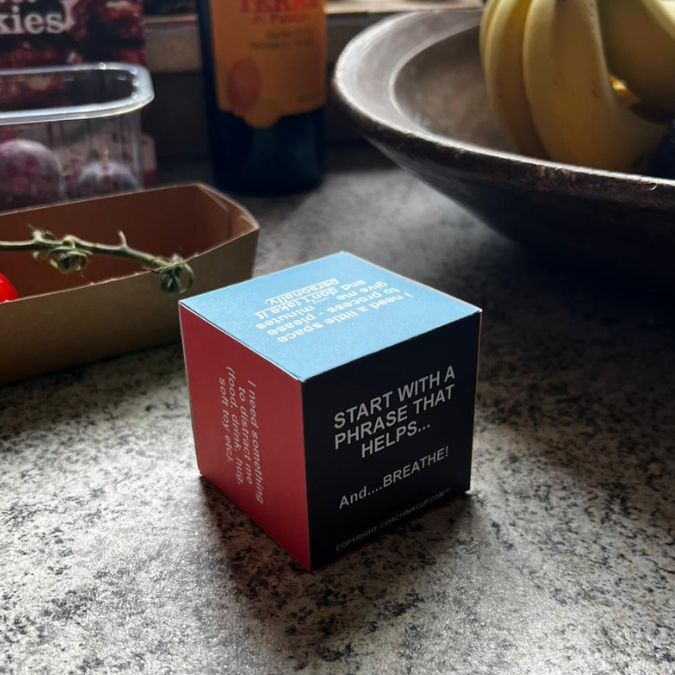
Some of what is in this book you will recognise from other communication work. The Cube is not one of those things. It is specific to this framework and it does something that surprises people when they first use it. Most of the time just picking up the cube helps more than anything else!! PS. There’s also a mug coming soon with the 5 Phrases on it!
Some of what is in this book you will recognise from other communication work. The Cube is not one of those things. It is specific to this framework and it does something that surprises people when they first use it.
For the reader who is not satisfied with surface explanations.
…who has noticed the gap between what they believe they are doing and what they are actually doing — and wants to understand why that gap exists at a level most frameworks never reach.
For the person who wants to be challenged more than reassured. Who is willing to sit with a question that does not have a comfortable answer, because they understand that the discomfort is where the useful thinking, and growth, starts.
AFTER YOU READ IT
The questions that will have answers
By the time you finish The Connection Code, the following questions have specific, practical answers. Before reading it, most people either haven’t thought to ask them, or have asked and found nothing solid to hold onto.
IN THE MOMENT
“How do I know which phrase to reach for when my brain has already started shutting down?”
WITH YOUR PARTNER
“How do we introduce this into our relationship without it feeling like a script or a therapy assignment?”
UNDER PRESSURE
“What happens if I know the phrase exists but I still can’t access it when the argument is already running?”
THEIR RESPONSE
“What if my partner uses a phrase and I don’t know what they’re asking for?”
OLD LOOPS
“Why do we keep ending up in the same argument even when we both agree we don’t want to?”
LONG TERM
“Can five phrases actually change the way two people connect, or is this just another short-term fix?”
THE AUTHOR’S STORY
I was the lead choreographer of communication disasters in my own relationships for years.
My marriage dissolved, partly because we couldn’t find ways to talk about things that mattered without both of us feeling attacked or misunderstood. My children grew up watching a father who was either fixing problems nobody asked him to fix, offering advice nobody wanted, withdrawing when emotions ran too high, or exploding when he had run out of any other option. Not my proudest period.
I am definitely not that man anymore and thankfully have a great relationship with both of my children now. And they’ll admit that in public!
Add to this the fact that I have ADHD, and not the quiet, distracted kind. The kind where thoughts disappear in the middle of a sentence, where listening and forming a response and remembering what was just said are all competing for the same limited space, and where the urge to interrupt arrives before the other person has finished their point.
What I eventually discovered is that poor communication isn’t a character flaw. It’s a skills gap. And skills can be learned, even when the brain makes it hard.
The five phrases in this book came out of thirty years of observation: in hospitality, in massage therapy, in coaching, in my own relationships. They are what I built when I realised that knowing what to do was never the problem. Having the right phrase ready, in the moment the loop was starting, before my brain had already run the old script: that was what was missing. That is what this book gives you.
IS THIS FOR YOU?
This book is for you if:
This book is for couples who are tired of the same patterns playing out on repeat. Not looking for a perfect relationship. Looking for a better one.
✓ You can predict exactly what the next argument is going to look like, and it still happens anyway.
✓ You love your partner and you keep having the same conversation that goes nowhere.
✓ You want tools that work in real moments, not techniques that require perfect emotional control to execute.
✓ You are willing to change your response before expecting your partner to change theirs.
✓ You want progress in your relationship, not perfection.
✓ You don’t just want more reactive answers that make things worse. This needs to work for real people.
This is not a book for someone who wants a theoretical framework or a list of principles to reflect on. It is a practical guide with specific phrases that require practise. You will need to introduce this with your partner. The book covers exactly how to do that. But there is work involved, and it only works if you do it.
GET THE BOOK!
You’ve got nothing to lose except the same argument you had last week.
Read The Connection Code once and the five phrases stay with you. Practise them and they are ready before the moment arrives. The loop breaks. Something different happens instead.

The version of you in five years is forming right now in the choices you make next — what are they hoping you do now?